

Quick Summary
Tall women style midi dresses by checking where the hem breaks on the leg, since mid-calf or just below the knee usually looks intentional. Measure against your knee and calf in the shoes you'll wear, and confirm the waist seam sits at your natural waist, not above or below it.
- Measure the hem against your knee crease, calf widest point, and ankle bone while barefoot.
- Aim for a hem 1 to 3 inches below the knee crease or halfway between knee and ankle.
- Treat any shoe-height change of more than 2 inches as a different outfit.
- Locate your natural waist with a string and check that the waist seam sits within 1 inch of it.
- A belt cannot fix a waist seam that is more than 2 inches off.
Table of Contents
- Why Midi Dresses Need Extra Thought on a Tall Frame
- Finding the Right Midi Length for Your Height
- Placing the Waist So the Dress Fits Your Torso
- Midi Dresses for Tall Women: Silhouettes That Flatter Your Frame
- How to Style a Midi Dress for Tall Proportions
- Midi Dress Outfit Ideas for Nights Out and Events
- Pairing a Midi Dress With Flats or Heels Without Losing Proportion
- Choose Your Next Midi Dress Based on These Fit Checks
- Frequently Asked Questions
Why Midi Dresses Need Extra Thought on a Tall Frame
A midi dress is one of the most flexible pieces in a closet, but tall women often find it fits in ways the brand photos never show.
Midi dresses usually fall between the knee and the calf. On a tall frame, that small range can make a big difference in how long your legs look and how balanced the outfit feels.
Here is what tall women tend to run into most often:
- Hems that stop at an awkward point on the leg
- Waistlines that sit too low on a long torso
- Fabric that shortens the body when it is cut too wide
These problems are fixable. You just need to know what to look for before you buy.
Finding the Right Midi Length for Your Height
Most midi-dress advice stops at "below the knee, above the ankle." That range is roughly 10 inches wide, which is why two tall women can buy the same labeled midi and get completely different results. The hem is not a single point, it is a relationship between your leg length, your shoe height, and where the fabric breaks.
Measure the Hem Against Your Own Leg, Not the Size Label
A midi dress is usually described by total length from shoulder to hem (sometimes called HPS, or high point of shoulder, to hem). On a tall frame, that number matters less than where the hem lands relative to your knee and calf. Use a soft tape measure and note three landmarks while standing barefoot:
- Knee center, the crease at the back of the knee.
- Calf widest point, usually 2 to 4 inches below the knee crease.
- Ankle bone, the top of the bony prominence on the outside of the ankle.
A midi that reads as intentional on a tall body typically breaks at one of two zones: just below the knee (roughly 1 to 3 inches below the knee crease) or at the mid-calf (roughly halfway between the knee crease and the ankle bone). For a deeper guide on choosing dress length for your body, see dress length for curves. A hem that lands right at the widest part of the calf tends to visually widen the lower leg, and a hem that stops within an inch of the knee can look like a shrunken maxi.
Adjust for the Shoes You Will Actually Wear
Hem placement shifts with footwear, so measure in the shoes you plan to pair with the dress. A 3-inch heel raises the hem roughly 3 inches off the floor and changes where the fabric breaks on the leg.
A practical rule: choose the hem in your most-worn shoe height, then treat any change of more than 2 inches as a different outfit. If you want one dress to work with both flats and heels, aim for a hem that sits at mid-calf in flats, it will rise to just below the knee in heels, which is still a clean break.
The Tall-Specific Hem Trap
Tall women often size up to get length, which adds width through the body and can drop the waist seam. Before you size up, check the garment's shoulder-to-hem measurement against a dress you already own that hits the right spot.
Pro Tip
Photograph the hem from the side, not just the front. A hem that looks level in a mirror can angle up in back on a long torso, which changes where the break reads.
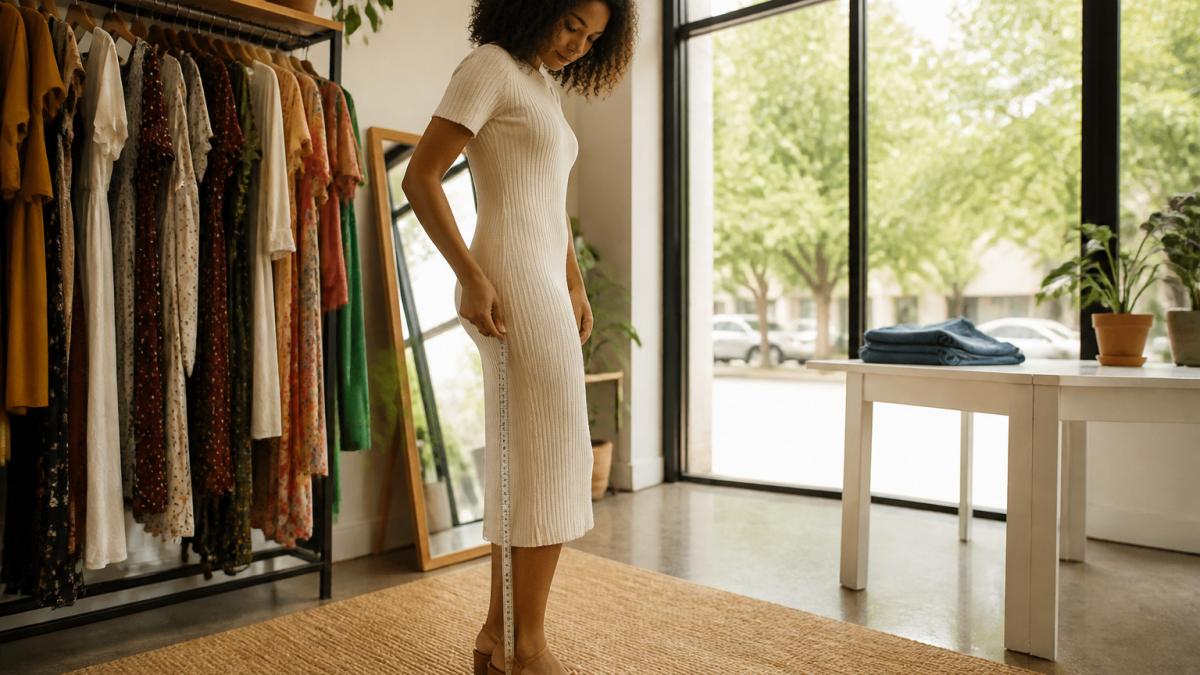
Hem placement depends on the three landmarks and the shoes you wear, so the article's key measurements are summarised below.
| Landmark or check | Measurement or rule | Note |
|---|---|---|
| Knee center | Crease at back of knee | Measure barefoot |
| Calf widest point | 2 to 4 inches below knee crease | Hem here can widen the lower leg |
| Ankle bone | Top of outside ankle bone | Reference for the lower end of the range |
| Good hem zone (knee) | 1 to 3 inches below knee crease | Reads as intentional |
| Good hem zone (mid-calf) | Halfway between knee crease and ankle bone | Clean break on a tall frame |
| Shoe height change | More than 2 inches | Treat as a different outfit |
| Heel height effect | Raises hem about 3 inches for a 3-inch heel | Changes where fabric breaks |
Placing the Waist So the Dress Fits Your Torso
On a tall frame, the waist seam is usually the first thing to fail, even when the hem is perfect. A dress cut for an average torso can put the waist seam an inch or two above your natural waist, which makes the bodice feel short and the skirt start too high. The reverse happens on a long torso: the seam drops toward the hip, and the dress reads as a dropped-waist style you did not ask for.
Find Your Natural Waist First
Before you evaluate any dress, locate your natural waist. Stand relaxed and bend slightly to one side, the crease that forms is your natural waist. It usually sits about 1 inch above the belly button, but on tall women it can sit higher or lower depending on torso length. Tie a string or thin elastic there and leave it on while you try dresses.
Diagnose the Seam, Not the Size
Try the dress on and compare the waist seam to your string:
- Seam more than 1 inch above the string: the bodice is short for your torso. The skirt will flare too high and the bust may feel compressed.
- Seam more than 1 inch below the string: the bodice is long. The dress will look like a drop-waist and can shorten the appearance of your legs.
- Seam within 1 inch: the waist placement is workable; adjust with a belt if you want more definition.
This check matters more than the size label. A tall woman may need a larger size for shoulder and bust room while the waist seam still sits too high, that is a proportion mismatch, not a fit failure.
Fixes That Actually Work
Take in the waist. A tailor can move a side-seam waist in by 1 to 2 inches without changing the skirt line. This is the most common fix for a dress that fits the shoulders and hips but gaps at the waist.
On Point - Tank Mid Back Cut Out Stretch Midi Dress →
Lower the waist seam. On dresses with a separate bodice and skirt, a tailor can drop the seam by 1 to 2 inches, but only if the bodice has seam allowance and the skirt has enough length. Ask before you buy; not every construction allows it.
Add a belt to redirect the eye. A belt worn at your natural waist can visually reset the proportion even when the seam is slightly off.
Choose adjustable waists. Wrap dresses, tie-waist styles, and elastic-shirred waists let you place the definition where your body wants it rather than where the pattern was drafted.
Watch Out
A belt cannot fix a waist seam that is more than 2 inches off. It will slide to the seam's position under tension, and the dress will still read as short- or long-waisted. Treat belts as a refinement, not a repair.
Check Shoulders and Sleeves at the Same Time
Waist placement rarely fails alone on a tall frame. While the dress is on, check that the shoulder seam sits at the edge of your shoulder (not inside it), that sleeves reach your wrist bone rather than stopping mid-forearm, and that the armhole does not cut into the underarm.
Midi Dresses for Tall Women: Silhouettes That Flatter Your Frame
Some silhouettes suit tall frames better than others. Fitted and bodycon styles show off a long, lean shape. A-line midis add movement and balance wider hips or shoulders.
For a stretch option that hugs the body, the On Point - Tank Mid Back Cut Out Stretch Midi Dress offers a sleek tank front and a back cut-out with a T-line detail.

If you prefer a polished silhouette, the You Had Your Chance - Spaghetti Strap Pearl Button Down Midi Dress is a curve-hugging option at $20.00, with pearl decorative buttons along the front.

How to Style a Midi Dress for Tall Proportions
Styling a midi for a tall frame comes down to balance. Here is a simple method you can use for almost any look:
- Pick one focal point. Let the dress, the shoes, or the jewelry lead, not all three.
- Define the waist. A belt or a fitted cut keeps the shape clear.
- Choose shoes that match the hem. A shoe that peeks out a little can extend the leg line.
- Keep layers light. Oversized jackets can overwhelm a long frame.
Midi Dress Outfit Ideas for Nights Out and Events
Midi dresses work well for nights out. Pair a fitted midi with gold jewelry, strappy heels, and a small clutch for a polished look. For a more relaxed evening, add a cropped denim jacket and white sneakers.
Pairing a Midi Dress With Flats or Heels Without Losing Proportion
Heels usually add the most height and keep the leg line long. Flats can still work, especially with a midi that ends at mid-calf. Pointed toes and simple straps help keep the leg visually longer.
Chunky platform sandals can also balance a long midi, as long as the hem does not drop too far below the shoe line.
Choose Your Next Midi Dress Based on These Fit Checks
Before you buy, run through these quick checks:
- Does the hem land at a flattering point on your leg?
- Does the waist seam sit at your natural waistline?
- Is the fabric stretchy enough to move comfortably?
Taking a minute to check these details can save you from returns and help you find midi dresses that make your height look intentional.
Frequently Asked Questions
What midi dress length works best for tall women?
For most tall women, a midi that falls between the mid-calf and just below the knee looks balanced because it does not cut the leg in an awkward place. Hem placement matters more than the label on the dress. Try the dress on with the shoes you plan to wear, since heel height changes where the hem lands. If the hem ends at the narrowest part of your calf, consider a slightly longer or shorter length to shift the visual line. Swagg Boutique's On Point Tank Mid Back Cut Out Stretch Midi Dress at $29.99 is cut to a midi length, so check the hem against your own height before ordering.
How do you style a midi dress with flats?
Midi dresses with flats work well for daytime events, brunch and casual nights out. Choose flats with a pointed or slim profile to keep the leg line long, and select a shoe in a tone close to your skin or the dress color. A cropped jacket or a structured bag adds shape without breaking the silhouette. Flats are a practical option for tall women who want to avoid extra height, and the look stays polished when the dress has a defined waist.
Which midi dress styles flatter a tall frame?
Fitted and bodycon midis, A-line cuts and empire waist styles each suit a tall frame when the proportions are right. A defined waist helps the dress look intentional on a longer torso. Satin and slip styles drape well on a tall body, while bold prints can add interest without overwhelming the frame. The Don't Have To Explain Chain Strap Faux Leather Dress at $19.50 is a midi with double side splits that adds movement for nights out.
How can tall women define their waist in a midi dress?
Look for midi dresses with a waist seam, belt loop or high waist panel that sits at your natural waist, not lower on the hip. On a longer torso, the waist can fall in the wrong place, so check where the seam lands when you try the dress on. A belted midi or a dress with a fitted bodice can help. The You Had Your Chance Spaghetti Strap Pearl Button Down Midi Dress at $20.00 has a curve-enhancing bodycon fit.

