

Table of Contents
- Dress Lengths for Curves: Start With Your Fullest Point
- How to Measure Your Hemline Before You Buy
- The Most Flattering Dress Length for Curvy Women
- Midi Dresses for Curvy Figures: Why the Hemline Works
- Dress Length for Petite Curvy Women: Shorter Hemlines, Bigger Impact
- Fabric and Construction: The Hidden Hemline Factor
- Shoes and Leg Line: The Final Hemline Check
- Conclusion: Your Hemline, Your Curves, Your Call
- Frequently Asked Questions
Last Updated: October 12, 2026
Dress Lengths for Curves: Start With Your Fullest Point
Choosing the right dress length for curves starts with one measurement: your fullest point. That is the widest part of your hips, and it sets the baseline for every hemline decision that follows.
At Swagg Bootique LLC, we have dressed women for birthdays, weddings, and nights out since 2011.
So here is the rule we give every customer. Find your fullest point first. Then choose a hemline that either hits above it or falls well below it.
Below, we break down the four core hemlines, how to measure before you buy, and which lengths flatter which curves.
The 4 Core Hemlines: Mini, Knee-Length, Midi, and Maxi
Every dress falls into one of four lengths. Each one changes how your proportions read from across the room.
- Mini: Ends above mid-thigh. Shows off legs but can cut the leg line short.
- Knee-length: Hits at or just above the knee. Classic and easy to wear.
- Midi: Falls between the knee and mid-calf. The most versatile length for curves.
- Maxi: Reaches the ankle or floor. Creates one long, clean line.
The Fashion Institute of Technology's guide to garment construction explains how hem placement changes the visual balance of an outfit. A hem is not just an ending point. It is a design decision that shapes how the whole dress reads.
How to Measure Your Hemline Before You Buy
You can measure a hemline at home in about two minutes. No fitting room required. This is the step most shoppers skip, and it is why so many online orders go back.
The Tape-Measure Test for Curves
Here is the method we walk customers through before they order:
- Stand in front of a full-length mirror in the shoes you plan to wear.
- Hold a soft measuring tape at your natural waist.
- Let it drop straight down to your fullest hip point. Note that spot.
- Now measure from your shoulder to where you want the hem to land.
- Mark that length on your body with a pin or a piece of tape.
- Step back and look. Does the line flatter you or cut you off?
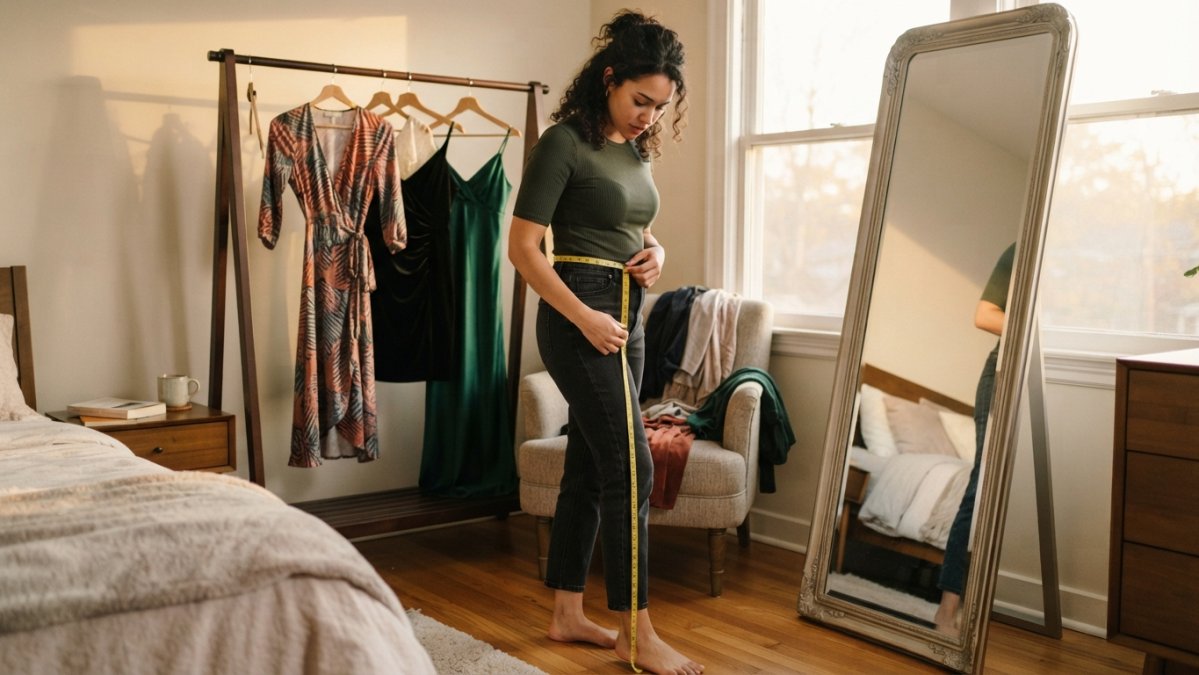
If the marked line sits right at your widest point, move it up or down a few inches. That small shift changes everything.
Pro Tip
Measure in the shoes you will actually wear. A 3-inch heel adds real length to your leg line and can turn a midi into a knee-length look. Most shoppers forget this and end up with a hem that sits wrong.
The Most Flattering Dress Length for Curvy Women
The most flattering dress length for curvy women is the midi. It covers the knee, skims the calf, and creates a long vertical line that balances wider hips and thighs.
Why does it work? A midi draws the eye down in one smooth line. It does not stop at your widest point. It does not chop your leg into pieces. It just flows.
That said, midi is not the only answer. Your height, your shoes, and the occasion all shift the math.
| Hemline | Best For | Watch Out For |
|---|---|---|
| Mini | Petite frames, showing legs | Cutting the leg line short |
| Knee-length | Balanced, everyday wear | Hitting the widest hip point |
| Midi | Most curvy figures, hourglass shapes | Ending at the calf's widest spot |
| Maxi | Tall frames, formal events | Overwhelming petite frames |
The Council of Fashion Designers of America's fit resources notes that silhouette and proportion matter more than any single size number. Fit is about balance, not labels.
Midi Dresses for Curvy Figures: Why the Hemline Works
Midi dresses for curvy figures work because they lengthen the body without hiding it. The hem falls below the knee, so the eye travels down a continuous line instead of stopping at the hip. That is the whole trick.
A midi also gives you room to play with waist definition. You can cinch it, belt it, or choose a cut that already nips in at the middle.
Our You Had Your Chance Spaghetti Strap Pearl Button Down Midi Dress is a good example. It has a curve-hugging bodycon fit, very good stretch, and a smooth inner lining. The pearl buttons run down the front and pull the eye vertically.

How to Style a Midi Dress for Curves
- Add a belt at your natural waist to define your middle.
- Choose heels or pointed flats to extend the leg line.
- Keep jewelry vertical: long chains, drop earrings.
- Skip heavy horizontal details at the hip.
Key Takeaway
A midi works on almost every curvy frame. The key is where it ends: just below the knee or at mid-calf, never right at the widest part of your calf.
Dress Length for Petite Curvy Women: Shorter Hemlines, Bigger Impact
Dress length for petite curvy women leans shorter. If you are 5'3" or under, a midi can swallow your frame and make you look shorter than you are. A knee-length or above-the-knee hem usually serves you better. The goal is to show more leg, because more visible leg means a longer visual line.
But height is only half the equation. The other half is where the hem lands on your body landmarks. Here is a practical method you can use at home or in a fitting room, standing, sitting, and walking.
You Had Your Chance – Spaghetti Strap Pearl Button Down Midi Dress →
The Landmark Try-On Method
Use these four landmarks to judge any hemline in under a minute:
- The widest hip point. Stand in front of a full-length mirror. Find the spot where your hip is widest. A hem that stops within an inch above or below this point will draw the eye sideways. Move the hem up or down.
- The knee crease. Bend your knee slightly. The crease is your knee landmark. A hem that hits right at the crease can shorten the leg line. A hem an inch or two above the crease keeps the line long.
- The widest calf point. Turn to the side. Find the widest part of your calf. A midi that ends right here cuts the leg line. A midi that ends above it or below it keeps the line flowing.
- The ankle bone. For maxi lengths, the hem should skim the top of your foot or break just above the ankle bone. A maxi that pools on the floor reads as too long, even on a tall frame.
The Sit, Stand, and Walk Check
A hemline that looks right standing still can fail the moment you move. Run these three checks before you commit:
- Stand: Check the hem against the four landmarks above. Look at the line from your shoulder to your hem. Is it unbroken?
- Sit: Sit on a chair and cross your legs. A mini or short knee-length will ride up. A midi may pull across the thigh. A maxi may bunch at the knee. If the dress pulls, tugs, or rides up more than an inch or two, size up or choose a different length.
- Walk: Take ten steps. A maxi should not catch under your foot. A midi should not wrap around your calf. A mini should not require constant tugging. If you have to adjust the hem while walking, the length is wrong for you.
Petite-Specific Adjustments
For petite frames, try:
- Knee-length dresses that hit just above the knee crease
- Mini dresses with a defined waist
- Midi dresses only if they end above the widest calf point
- Maxi dresses only with a heel, so the fabric does not pool
One more thing. A petite frame with curves needs waist definition even more than a taller frame does. Without it, a flowy dress can read as boxy. With it, you get shape and length at the same time.
Key Takeaway
The landmark method works at any height. For petite curves, the rule is simple: keep the hem away from your widest hip point, your knee crease, and your widest calf point. If a hem lands on any of those three, move it up or down.
Fabric and Construction: The Hidden Hemline Factor
Fabric decides how a hemline actually behaves on your body. This is the part most guides skip, and it matters as much as the length itself.
A stiff fabric holds its shape and can stand away from the body. That can hide curves or add bulk. A stretch fabric moves with you and follows your shape. For curves, stretch is usually your friend.
Look for these when you shop:
- Stretch content: A little spandex helps the dress move with you.
- Lining: A smooth lining keeps the fit clean and comfortable.
- Weight: Lightweight fabric drapes; heavy fabric can add bulk.
- Seams: Well-placed seams shape the waist and hip.
Our Dazed Stretch Tube Tie Dye Midi Dress uses a soft stretch fabric with a fitted bodycon silhouette. It contours through the bust, waist, and hips. That construction is what makes the midi length work on a curvy frame.

Watch Out
A boxy, stiff dress in the right length can still look wrong. If the fabric does not move with your body, the hemline cannot save the fit. Check the stretch level before you buy.
Shoes and Leg Line: The Final Hemline Check
Shoes change where your leg line ends, and that changes how your hemline reads. This is the last check before you commit to a length.
A nude or skin-tone shoe extends the leg because it blends with your skin. A dark shoe creates a clear stop point. Neither is wrong, but they do different things.
- With a midi: Nude heels or pointed flats keep the line long.
- With a mini: Strappy heels or boots add height and balance.
- With a maxi: A heel keeps the fabric from pooling.
- With a knee-length: Almost any shoe works; match the vibe.
Try the dress with the shoes you plan to wear before you decide. The same midi can look completely different with a heel versus a flat.
Conclusion: Your Hemline, Your Curves, Your Call
Finding the right dress length for curves comes down to three things: your fullest point, your height, and your shoes. Measure first. Then choose a hemline that either clears your widest point or falls well below it. Midi flatters most curvy frames, but petite curves often do better with a shorter hem.
Swagg Bootique LLC drops new styles every week, with fast shipping for last-minute events. Our On Point Tank Mid Back Cut Out Stretch Midi Dress brings a super stretchy, double-lined fit that hugs your curves just right.

Get started with Swagg Bootique LLC and find the hemline that makes your curves the main event.
Frequently Asked Questions
What type of dress is most flattering for curvy people?
The most flattering dress for curves depends on your body shape, but a midi dress with a defined waist is a strong starting point. A hemline that hits at or just below the knee draws the eye to your waist and creates a balanced silhouette. Look for fabric with stretch, like the You Had Your Chance midi dress, which has a curve-enhancing bodycon fit and very good stretch.
Are midi dresses flattering on curvy figures?
Yes. Midi dresses for curvy figures work because the hemline lands between the knee and mid-calf, which lengthens the leg line without hiding your shape. A fitted midi with stretch, like the Dazed Tie Dye Midi Dress, contours the bust, waist, and hips while keeping the look polished. Pair with heels to extend the leg line further.
How do I choose a dress length for my height and curves?
Start with your height. Petite curvy women (5'3" or shorter) often look best in knee-length or mid-calf hems that do not overwhelm their frame. Taller curvy women can wear maxi or midi lengths with ease. Then check the hem against your fullest point: the hem should not cut across the widest part of your hips or thighs. A dress like the To Be Continued halter maxi gives you a long line if you are taller.
What shoes should I wear with different dress lengths?
The right shoe depends on the hemline. Mini dresses pair well with strappy heels or knee-high boots to balance the exposed leg. Midi dresses look best with pointed-toe heels or nude pumps that extend the leg line. Maxi dresses work with platform sandals or block heels. For a petite curvy frame, a nude heel with a midi or knee-length dress creates the longest visual line.