

Last Updated: October 24, 2026
Quick Summary
To spot red flags in online clothing listings, check that photos match the description, sizing charts list real measurements, the brand has a verifiable paper trail, and the return policy is clear. Walk away from prices that are too low, countdown timers that reset, and listings with no fabric details or label photos.
- Zoom in on edges, shadows, and hands to identify fake product photos before buying.
- A trustworthy size chart lists bust, waist, and hip numbers plus model height and size worn.
- Verify a brand through domain age, business registration, social history, and a real contact method.
- If two or more return policy boxes stay unchecked, treat the listing as high risk.
- Document red flags with screenshots and report the listing to the platform.
Table of Contents
- Why Red Flags in Online Clothing Listings Cost You More Than a Bad Dress
- 1. Product Photos That Don't Match the Listing
- 2. How to Identify Fake Product Photos Before You Buy
- 3. Sizing Details That Are Missing or Vague
- 4. How to Check if a Clothing Brand Is Legit
- 5. How to Spot Fake Clothing Websites and Sketchy Sellers
- 6. Reviews That Sound Too Good, Too Generic, or Too Angry
- 7. Your Online Clothing Return Policy Checklist
- What to Do After You Spot a Red Flag
- Frequently Asked Questions
Why Red Flags in Online Clothing Listings Cost You More Than a Bad Dress
Most shoppers think a bad purchase costs them the price of one dress.
Learning how to spot red flags in online clothing listings is the skill that protects all of it. For a deeper walkthrough, see our tips for buying dresses online safely.
Here's the part most guides miss: the biggest tells rarely live in the dress photo. They live in the details around it.
1. Product Photos That Don't Match the Listing
The first red flag is a photo that doesn't match the words next to it. If the title says "satin midi dress" and the photo shows matte jersey, stop. If the color name says "champagne" but the image looks bright yellow, stop.
Clothing-specific photo checks catch what generic advice misses:
- Fabric sheen: Does the light reflect the way the fabric name suggests?
- Length: Does the hem in the photo match the stated measurements?
- Details: Are there buttons, zippers, or seams in the photo that the description never mentions?
That last one matters. A seller who swaps dresses onto one identical background is often selling photos, not inventory.
2. How to Identify Fake Product Photos Before You Buy
How to identify fake product photos: zoom in on edges, shadows, and hands. Stolen or altered images usually show blurred boundaries, mismatched shadows, or distorted hands, the fastest giveaway.
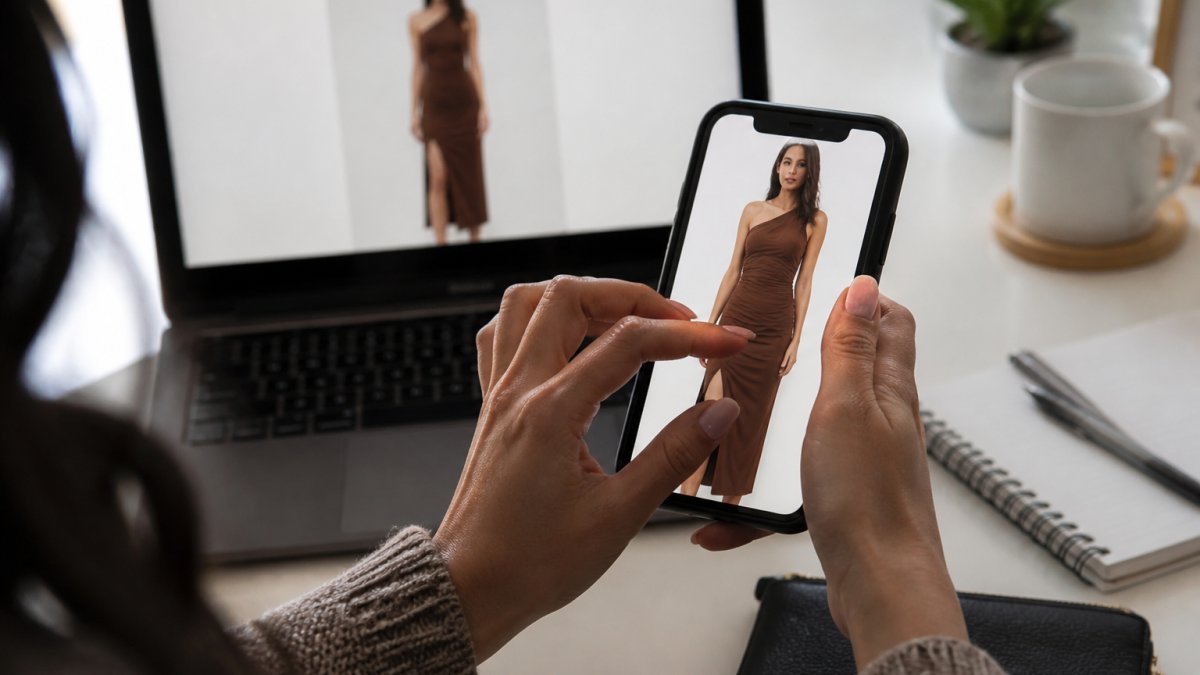
Run these checks before you trust any image:
- Reverse image search. Save the photo and search it. If it appears on five unrelated sites, it's borrowed.
- Check the shadows. Floating hems signal a cut-out job.
- Look at the model twice. The same model across unrelated brands usually means a stock photo.
- Zoom on the fabric. Real product shots hold texture when enlarged; fake ones turn to mush.
The Federal Trade Commission's guidance on online advertising and endorsements makes clear that images used to sell a product must not deceive buyers.
One more insider tip: check whether the listing shows the garment from the back. Legit sellers photograph both sides. Scammers rarely bother.
3. Sizing Details That Are Missing or Vague
Vague sizing is the most common red flag in online clothing listings, and the most expensive. "One size fits most" on a fitted dress is a warning, not a convenience.
A real size chart gives numbers, not letters. For each size offered, it should list:
- Bust, waist, and hip circumference in inches, measured flat and doubled where relevant.
- Length from shoulder to hem, and for dresses, the length from waist to hem.
- Inseam and rise for pants, and sleeve length for tops.
If the chart lists only S/M/L with no numbers, you are guessing. If it lists numbers but no fabric or stretch, you are still guessing, because the same 28-inch waist behaves differently in rigid denim and in a knit.
Measure yourself once, then compare
Take your bust, waist, and hip measurements with a soft tape over light clothing, and write them down. Compare against the chart, not the size you wear at a favorite store, vanity sizing varies widely, so a "medium" at one retailer can match a "large" at another. The chart is the only common language.
Watch for these sizing red flags:
- "Runs small, size up" with no measurements. That is the seller guessing on your behalf.
- A chart that is identical across every product. Real garments have different cuts; a copied chart is a copied listing.
- No stretch information on a fitted garment. A bodycon dress with no stretch percentage is either misdescribed or unwearable.
Fabric and construction change the fit
Two dresses with the same bust and waist measurements can fit completely differently depending on fabric and construction. Bias-cut garments stretch and skim; a structured bodice holds its shape; a knit with 4-way stretch forgives an inch, while a woven with no stretch does not. Check whether the listing mentions lining, boning, elastic waistbands, or adjustable straps, each changes how forgiving the fit will be.
Ask yourself three questions before you buy:
- Does the chart list measurements for every size offered, plus model height and size worn?
- Does the description name the fabric, its stretch, and any lining or structure?
- Does the seller explain the intended fit, like "bodycon," "relaxed," or "true to size," and back it with numbers?
If any answer is no, message the seller before buying. Ask one specific question, for example, "What is the waist measurement on the size 8, and does the fabric have stretch?" A seller who answers with numbers is running a real operation; one who replies "it fits true to size" without data is not.
Pro Tip
Save your measurements in a note on your phone. Once you have them, every listing check takes seconds instead of minutes.
4. How to Check if a Clothing Brand Is Legit
To check if a clothing brand is legit, verify four things: a real contact method, a physical business address, consistent branding, and a track record that predates the current season. Missing any one deserves a second look. For clothing specifically, the fastest verification is not the About page, it is the garment details and the paper trail behind the brand.
Start with the paper trail
- Domain age. A newly registered domain running a big seasonal sale is a classic scam pattern. Free WHOIS lookup tools show the registration date in seconds.
- Business registration. Many states let you search business filings online. A registered LLC with a matching address is a good sign; no filing at all is not.
- Social history. Scroll back a full year. Real brands have posts, tagged customers, replies, and stories referencing past seasons. A feed that starts three weeks ago with fifty product shots is a storefront, not a brand.
The Better Business Bureau's scam tracker is a fast way to see whether other shoppers have complained. Search the brand name before you enter card details.
Then check the clothing-specific tells
A legitimate clothing brand is consistent about what it sells and how it describes it. Look for:
- Consistent labels and tags. Real brands show the inside label, the care tag, and the fabric composition. Listings that never show a label, or show a label that changes between photos, are a warning.
- Construction details in the copy. Seams, lining, closures, and fabric weight are things a real seller knows and mentions. A listing that describes only color and vibe is hiding the garment.
- Authenticity claims that can be checked. If a listing claims a designer brand, the label, the stitching, and the hardware should match what that brand actually produces. Unsupported "authentic" claims with no label photos are a red flag.
Test the seller with one question
Send one specific question about sizing, fabric, or shipping. A real seller answers with numbers and specifics; rudeness, silence, or a copy-paste reply that ignores the question are reasons to leave. This test catches more fake brands than any checklist, because scammers run many storefronts and cannot afford to answer detailed questions well.
A brand that has been selling for years has a paper trail: filings, reviews, tagged customers, and a social history that predates the current season. For a shortcut, our guide on shopping for trendy outfits covers how to vet a store before you commit, and our list of online boutiques with fast shipping is a starting point for stores that have already passed a basic check.
Watch Out
If a brand passes the paper-trail check but fails the clothing-specific tells, no labels, no fabric details, prices too low, treat it as a reseller of unknown goods, not a brand. The risk is the same.
5. How to Spot Fake Clothing Websites and Sketchy Sellers
How to spot fake clothing websites: watch for prices that are too low, countdown timers that never end, and checkout pages that skip real payment options. Those three signals catch most scams.
Here's what a fake store usually looks like:
- Every item is discounted 70% or more, all the time.
- A countdown timer resets when you reload the page.
- The only payment option is a wire transfer or gift card.
Seller communication is the other test. Send one question about sizing or shipping. A real seller answers with specifics. Rudeness, silence, or copy-paste replies are reasons to leave.
For a deeper walkthrough, our guide on shopping for trendy outfits covers how to vet a store before you commit.
6. Reviews That Sound Too Good, Too Generic, or Too Angry
Reviews are easy to fake, so read them like a detective. Fabricated reviews tend to share one voice, one length, and one burst of posting dates.
These patterns should raise your guard:
- All five stars, all posted the same week.
- Generic reviews that never mention the fabric, fit, or event they wore it to.
- Reviews that name the wrong product or describe a different item.
The FTC's rules on fake reviews and testimonials now prohibit buying or selling fake reviews outright.
Sort reviews by newest and by lowest rating. That's where the truth hides. A brand that answers its critics earns more trust than one with a perfect score.
7. Your Online Clothing Return Policy Checklist
A return policy is the seller's promise, so read it before you pay. Score each line:
- Return window stated in days, not "promptly"
- Refund issued to the original payment method
- Return shipping cost named clearly
If two or more boxes stay unchecked, treat the listing as high risk. A seller who hides the return terms is telling you something.
Also check shipping cost and estimated delivery date.
If you're unsure whether a boutique is worth the risk, our piece on why boutique fashion is worth it explains what you're actually paying for.
Score each line before you pay, if two or more boxes stay unchecked, treat the listing as high risk.
| Return policy item | What to confirm |
|---|---|
| Return window | Stated in days, not "promptly" |
| Refund method | Issued to the original payment method |
| Return shipping | Cost named clearly |
| Restocking fees | Disclosed, if any |
| Final-sale items | Marked on the product page |
| Return address and process | Explained |
| Starting a return | Contact method provided |
What to Do After You Spot a Red Flag
When you find a red flag, don't argue with the seller. Document it and move on. Take screenshots of the listing, the price, and the return terms.
Then report the listing to the platform. Marketplaces act faster when shoppers flag specific listings with evidence. Your report protects the next buyer.
And if you're building an outfit around one key piece, read our guide on essential items for a versatile trendy outfit so one bad purchase doesn't sink the whole look.
Frequently Asked Questions
What are the biggest red flags in an online clothing listing?
The biggest red flags are photos that don't match the product, missing or vague sizing details, generic or fabricated reviews, no clear return policy, and prices that seem too low for the brand or fabric. A seller who dodges questions about measurements, fabric content, or shipping timelines is another warning sign. Before you order, read the full product description, check the return window, and look for real customer photos. If several of these signals show up together, walk away and spend your money somewhere that earns it.
How can I tell if clothing product photos are stolen or misleading?
Run a reverse image search on the main product photo to see if it appears on other websites under different brand names. Look for inconsistent lighting, backgrounds, or model faces across a single listing, which often means images were pulled from multiple sources. Check whether the seller shows the same garment from several angles, including close-ups of seams, tags, and fabric texture. Legit boutiques photograph their own inventory. If every photo looks like a catalog shot with no detail images, treat it as a red flag and ask the seller for a real photo before buying.
What should I check in an online clothing return policy before placing an order?
Confirm the return window in days, who pays return shipping, whether refunds are cash or store credit, and whether sale items are final sale. Look for a written policy page on the seller's site, not just a line in a chat message. Check that the policy covers items that arrive damaged or don't match the listing. Save a screenshot of the policy at checkout in case the terms change. A boutique that clearly states its return and refund policy upfront is easier to trust than one that hides the details.
What should I do if I spot red flags after I've already ordered?
Act fast. Screenshot the listing, your order confirmation, and any seller messages before anything changes. If you paid by credit card, you may have chargeback rights under the Fair Credit Billing Act for items not received or not as described. File a dispute with your card issuer or payment platform like PayPal within their stated window. Contact the seller in writing first and keep the tone factual. If the item arrives and doesn't match the listing, request a return in writing and keep tracking numbers for every shipment.
The real challenge isn't finding a dress. It's finding a seller who tells you the truth about it. At Swagg Bootique LLC, we photograph every piece from multiple angles, publish real measurements, and ship fast because we know your event won't wait. New drops land weekly, and our VIP list gets first access plus 10% off your first order. Get started with Swagg Bootique LLC and shop pieces you can trust before the big night.

