

Table of Contents
- Pink Lily vs Boutique Quality: The Real Difference
- Fabric and Stitching: How to Check Clothing Quality Online
- Sizing Consistency and the Fit Problem
- Fast Shipping vs. Wait Times: Best Online Boutiques for Fast Shipping
- Price per Wear: Is Pink Lily Worth It?
- Pink Lily Alternatives That Prioritize Quality Control
- Which Boutique Quality Standard Fits Your Wardrobe?
- Frequently Asked Questions
Last Updated: September 6, 2026
Pink Lily vs Boutique Quality: The Real Difference
The debate over pink lily vs boutique quality comparison has intensified as shoppers grow tired of guessing whether an online order will match its photos. Most guides treat this as a matter of personal taste, but the data tells a clearer story about what separates a curated boutique from a mass-market operation.
A boutique quality standard means pieces are selected for fabric weight, construction, and trend relevance rather than ordered in bulk from the same catalogs that stock fast-fashion giants. Shoppers increasingly want the curated aesthetic of a boutique with the reliability of a major retailer. Pink Lily holds a TrustScore of 4.5 out of 5 stars based on 409 customer reviews, yet those same reviews reveal polarized opinions on material consistency that any smart shopper should weigh.
Below, we break down how to check fabric and stitching online, what sizing data actually tells you, and whether the price per wear justifies the hype.
What the Reviews Actually Say About Pink Lily
Customer sentiment on Pink Lily splits in a telling direction. The brand maintains a 4.5-star TrustScore, but reading through the 409 reviews on Trustpilot shows praise for specific dresses alongside frustration about items that miss the mark. One independent review from Whimsy Soul found that ordered items featured legitimate fabrics and well-crafted stitching, directly contradicting claims that the brand ships fast-fashion quality at elevated prices.
The pattern points to inconsistency rather than systemic poor quality. Some production runs deliver garments that hold up to repeated wear, while others feel thinner than expected for the price point. This is the core tension in any pink lily vs boutique quality comparison: you are rolling dice on which batch your order comes from.
Watch Out
Do not judge an entire boutique by a single review, positive or negative. Look for patterns across multiple sources, especially recent ones, before committing to a purchase.
Fabric and Stitching: How to Check Clothing Quality Online
Checking clothing quality online starts with reading fabric composition listings, not just admiring the photos. Natural materials like cotton and linen breathe better and typically last longer than synthetic fibers, but blends often provide the stretch that going-out silhouettes require. Look for the percentage breakdown on every product page; a dress labeled "polyester" without a blend ratio is a red flag for thin, sweat-prone fabric.
But a fabric name alone is not enough. The real test is fabric weight, measured in grams per square meter (GSM). Most fast-fashion dresses fall in the 90-120 GSM range; a genuine boutique-quality piece typically starts around 150 GSM for a woven dress and 180-220 GSM for a knit. If GSM is not listed, look for cues like "heavyweight" or "structured", phrases like "lightweight" or "flowy" often mean the fabric is thin enough to be see-through.
Stitches per inch (SPI) is a reliable proxy for construction quality. Commercial fast-fashion lines often run at 6-8 SPI; boutique-quality garments typically hit 10-12 SPI. You cannot count stitches from a product photo, but you can zoom in on the stitch line, if you can see gaps between stitches, the seam will likely pull apart after a few wears.
Zoom into product photos and examine seam lines. Straight, tight stitches with no loose threads indicate better quality control, while wavy or uneven seams suggest rushed production. Customer photos in reviews are your best evidence, since they show how the garment actually drapes on a real body.
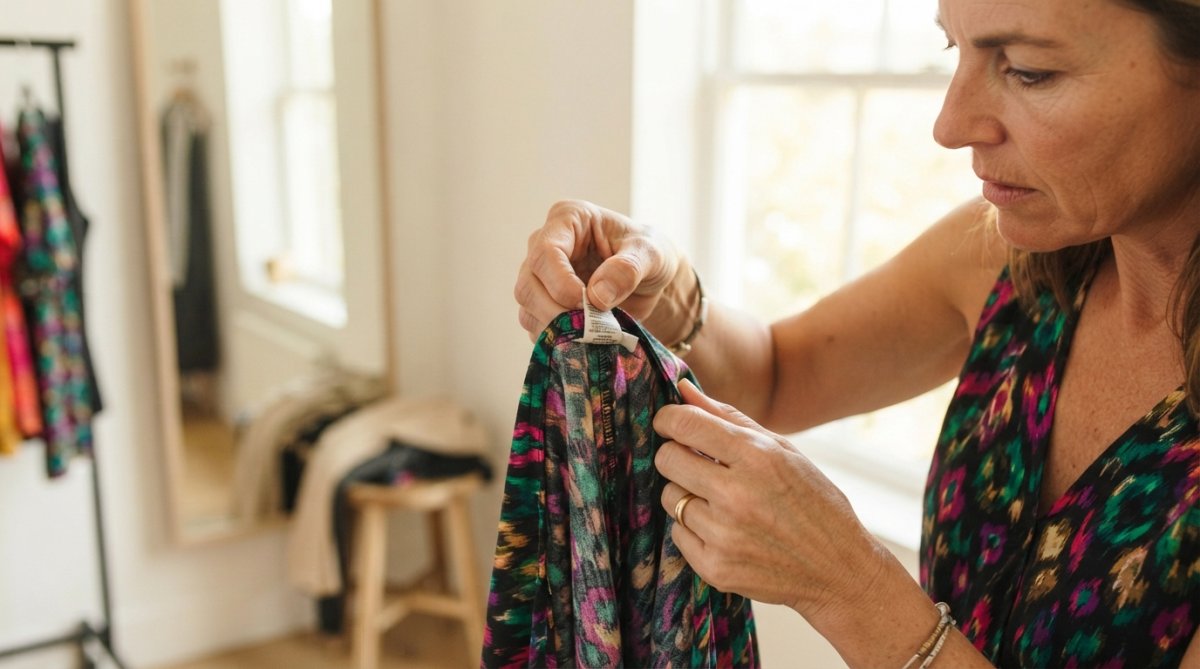
A practical trick used by fabric buyers: the pinch test. When the garment arrives, pinch a fold of fabric between your thumb and forefinger. If the fold is thicker than a dime, the fabric has substance. If you can see your fingernail through a single layer, the material is too sheer. It is a fast way to separate a $60 dress that feels like a $20 dress from one that feels like a $90 dress.
The demographic data on Pink Lily's audience shows an average age of 33 with only 11% male viewers Rascasse audience analysis, confirming that their core shopper is a woman buying for herself, often for events. That shopper deserves to know whether a $60 dress will survive more than one night out.
Pro Tip
Order a swatch or fabric sample when a boutique offers one. For shoes and accessories, check the product description for material composition details like "faux fur upper" or "rubber outsole" to confirm you are getting what the photos imply.
One more check that most guides skip: the seam allowance. Look at the inside of the garment at the side seam. An allowance of at least 5/8 of an inch (about 1.5 cm) means the maker left room for alterations or repairs. Fast-fashion pieces often use a 1/4-inch allowance, which means the first wash can cause the seam to unravel. It is the single best predictor of whether a garment can be tailored, and therefore last beyond a single season.
Sizing Consistency and the Fit Problem
Sizing inconsistency is the single biggest complaint across boutique shoppers, and Pink Lily is no exception. A size medium in one style may fit perfectly while the same cut in another runs small or large. This happens because boutiques source from multiple manufacturers, each with its own size chart.
The fix is to measure yourself and compare against each product's specific size chart, not the brand-wide one. For example, the Kanda.....Jewell Band Sandal Slides at $10.00 are noted as true to size, while the Full Moon-15- Double Fur Strap Slides state that measurements are based on a size 6 shoe with slight variations possible. That level of detail signals a boutique that has done the work on fit consistency.


But here is the gap that almost no review covers: published size charts often do not match the actual garment measurements. Published size charts often do not match the actual garment measurements. This is an industry-wide issue caused by manufacturers using "fit models" who do not represent the average shopper.
To protect yourself, use this real-world measurement protocol before you order:
- Measure a garment you already own that fits you well. Lay it flat, measure across the bust (armpit to armpit), the waist (narrowest point), and the hips (widest point). Double the numbers for full circumference.
- Compare those numbers to the product's size chart, not the brand's general chart. If the product page does not list garment measurements, email customer service and ask for the flat-lay measurements of that specific style.
- Add 1-2 inches of ease for woven fabrics (no stretch) and 0-1 inch for knits with spandex or elastane. A dress that measures 34 inches across the bust will fit a 34-inch bust only if it has stretch; without stretch, you need at least 36 inches.
- Check the stretch content percentage. A fabric with 5% spandex will recover its shape; a fabric with 2% or less will bag out at the elbows and knees after a few hours of wear.
| Fit Factor | What to Check | Why It Matters |
|---|---|---|
| Size chart accuracy | Compare garment measurements to your own | Prevents ordering the wrong size |
| Stretch content | Look for spandex or elastane percentage | Determines how forgiving the fit is |
| Customer fit reviews | Search for your height and weight | Shows real-world fit, not model photos |
| Return policy | Confirm free exchanges are offered | Protects you when sizing misses |
Watch Out
If a product page lists only S/M/L without numeric measurements, treat it as a red flag. Boutiques that invest in fit consistency publish garment dimensions because they know returns cost them money.
For shoes, the same logic applies but with a twist. Shoe sizes are not standardized across manufacturers, and a size 8 in one factory is a size 8.5 in another. Look for footbed length in centimeters or inches, this is the only reliable metric. A size 8 sandal with a 9.8-inch footbed will fit differently than one with a 10.2-inch footbed, even though both are labeled size 8. The Alanis....Criss Cross Quilted Band Sandal Slides list heel height and sole composition, which helps, but the footbed length is the number that actually prevents a return.
This measurement-first approach is the difference between guessing and knowing. It takes five extra minutes per order, but it cuts the return rate dramatically, and it is the single most useful habit for anyone shopping across multiple boutiques with inconsistent sizing standards.
Fast Shipping vs. Wait Times: Best Online Boutiques for Fast Shipping
Shipping speed has become a battleground in online fashion, and the best online boutiques for fast shipping use it as a competitive weapon. Some boutiques now advertise 2-3 day standard shipping windows as a differentiator against slower marketplaces Swagg Boutique shipping standards. When you need an outfit for a birthday party in ten days, a boutique that ships in two days beats one that takes a week just to process the order.
Pink Lily's shipping times vary by warehouse and product availability, adding another layer of uncertainty. Fast fashion giants often offer quick delivery, but the trade-off is a higher likelihood of quality control issues. The sweet spot is a boutique that stocks inventory locally and ships within 48 hours, cutting both the wait and the risk of damaged goods from long-distance transit.
Key Takeaway
If you are shopping for a specific event date, filter for boutiques that state their shipping windows clearly. A stated 2-3 day window is more reliable than a vague "ships in 5-7 business days" promise.
Price per Wear: Is Pink Lily Worth It?
Price per wear is the honest metric for judging any fashion purchase. Divide the cost by the number of times you will realistically wear it. A $70 dress worn twice costs $35 per wear; worn ten times, it drops to $7 per wear, beating a $20 fast-fashion piece worn once.
Pink Lily sits in a tricky middle zone. Their price points are higher than fast fashion but lower than premium boutiques, and the quality inconsistency means your cost-per-wear could go either direction. A well-constructed piece could last for years, while a poorly made one might not survive its first wash. Your experience depends heavily on which specific items you order.
Boutique alternatives that prioritize quality control often deliver a more consistent cost-per-wear because their garments are tested for durability before hitting the site. The Jackie-03 Jelly Flat Fur Sandal Slides at $10.00, for instance, list their full composition (faux fur upper, PVC insole, rubber outsole) so you know exactly what you are buying.

Pink Lily Alternatives That Prioritize Quality Control
For shoppers who want the boutique aesthetic without the quality lottery, several Pink Lily alternatives have built their reputation on stricter quality control. These boutiques typically order smaller batches, inspect each production run, and publish detailed material and sizing information on every product page.
The Mino.....Clear Flap Sandal Slides at $10.00 exemplify this approach with explicit details about the 1.5-inch heel, square toe, and rhinestone detailing, plus a true-to-size fit note. The Alanis....Criss Cross Quilted Band Sandal Slides follow the same pattern, listing the quilted sole and heel height so there are no surprises at delivery.
| Alternative | Quality Focus | Price Point | Best For |
|---|---|---|---|
| Pink Lily | Trend variety, inconsistent QC | $40-$80 | Trend-driven shoppers who accept risk |
| Swagg Boutique | Detailed specs, true-to-size fits | $10-$60 | Event shoppers needing reliability |
| Premium boutiques | Fabric testing, limited runs | $80-$150 | Wardrobe staples that last |
Which Boutique Quality Standard Fits Your Wardrobe?
The right boutique quality standard depends on what you are buying and how often you will wear it. For a one-time event, a trend-driven piece at a lower price point makes sense. For wardrobe staples you will rotate all season, prioritize boutiques that publish fabric composition and sizing data, even if it costs more upfront.
Pink Lily works for shoppers who enjoy the hunt and accept that some orders will miss. The brand's 4.5-star TrustScore suggests most customers leave satisfied, but the vocal minority highlights real consistency issues. If your budget is tight or your event date is fixed, choose a boutique that removes the guesswork through transparent product details and stated shipping windows.
Shopping for going-out fashion should feel exciting, not like a gamble. The challenge is finding pieces that match their photos, fit your body, and arrive in time for the occasion. Swagg Boutique solves that with new drops weekly and fast shipping so your outfit arrives with days to spare. Join the VIP list for 10% off your first order and get early access to pieces that actually deliver on boutique quality.
Get started with Swagg Boutique and make your next event one to remember.
Frequently Asked Questions
Is Pink Lily clothing good quality?
Customer feedback on Pink Lily quality is mixed. The brand holds a 4.5 out of 5 TrustScore on Trustpilot based on 409 reviews, with some buyers praising the fabric and stitching. However, others report inconsistent material quality, with some items feeling comparable to mass-market fast fashion despite higher prices. An independent review found the items ordered featured legitimate fabrics and well-crafted stitching. For consistent quality, look for boutiques that emphasize quality control and detailed fabric composition in their product descriptions.
How does Pink Lily compare to other online boutiques?
Pink Lily competes with other online boutiques on style variety and price point, but quality consistency is a common concern. Unlike some competitors, Pink Lily has a large following, which can lead to longer shipping times. Boutique alternatives often differentiate by offering faster shipping and more curated collections. When comparing, focus on customer service responsiveness, return policies, and whether the boutique provides detailed fabric and measurement information to ensure you get what you expect.
What should I look for when comparing boutique clothing quality?
Start by checking the fabric composition listed in the product description. Natural materials like cotton and linen generally breathe better, while synthetic fibers like polyester can vary widely in quality. Look for detailed close-up photos of the stitching and seams. Read reviews that mention durability after multiple washes and fit consistency. A reliable boutique will offer a clear sizing guide with actual garment measurements, not just S/M/L options. This helps you avoid the guesswork that leads to returns.
Are there better alternatives to Pink Lily for trendy fashion?
Yes, several boutiques offer strong alternatives to Pink Lily for trendy fashion. Shoppers seeking faster shipping often prefer smaller boutiques that offer fast delivery windows. When evaluating Pink Lily alternatives, compare their quality control processes, customer support responsiveness, and return policies. Look for brands that publish customer photos and detailed reviews. A boutique with a consistent track record on stitching quality and fabric weight, plus transparent sizing, often provides better value for special occasion outfits.
Why do some Pink Lily pieces cost more than fast fashion?
Pink Lily positions itself as an online boutique with a curated aesthetic rather than a mass-market retailer. The higher price point reflects trend-driven designs and a boutique experience. However, some customers question the value when quality feels similar to fast fashion. To determine if the price is fair, calculate the cost-per-wear. If a dress lasts through multiple seasons and washes without losing shape, the higher upfront cost is justified. If stitching fails after a few wears, it is not a good value.